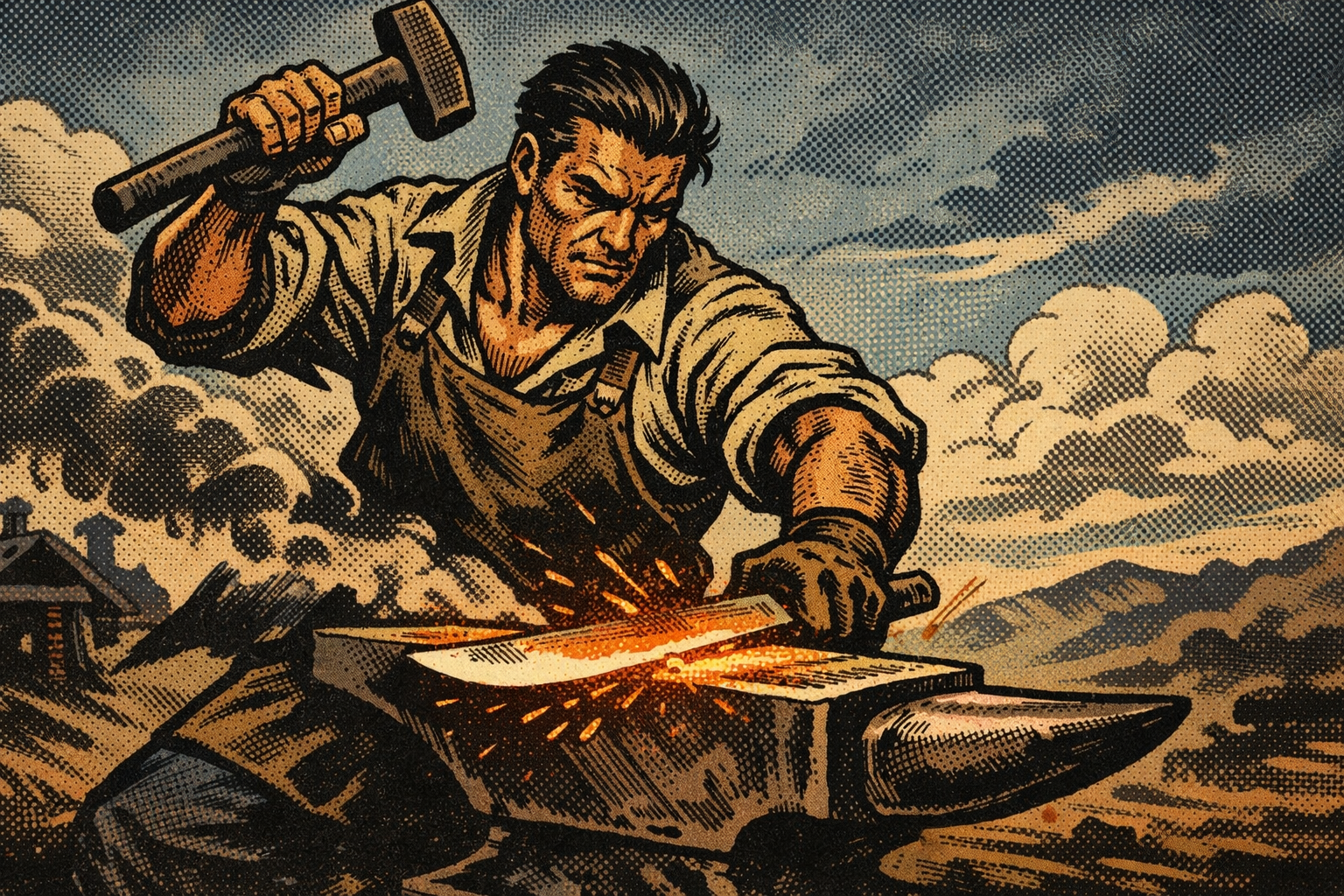
A man stands at the edge of his own week the way a blacksmith stands before an anvil- surrounded by tools, raw material within reach, heat available on command. He has read the books, bought the journal, set the alarm earlier than necessary. He has circled habits in red ink and highlighted virtues in yellow. Yet by Thursday, something loosens. By Sunday, something slips. The heat was real. The intention was sincere. But the steel remains unshaped.
We like to believe that effort alone changes a life. We admire intensity. We celebrate grind. But effort without definition diffuses. Energy without identity disperses. Before a man grows stronger, he must decide what he is strengthening into.
Clarity precedes strength. Not clarity about tasks, but clarity about identity. Until a man names who he is becoming, his discipline will remain moody, his decisions reactive, and his progress inconsistent. Definition is not a motivational accessory. It is the architecture that allows force to gather and hold.
When Energy Has Nowhere to Land
Most men attempt self-improvement as accumulation. More habits. More goals. More metrics. They track water intake, protein grams, books read, steps walked. There is nothing inherently wrong with this. But without an organizing identity, each habit floats on its own. There is no gravity holding them together.
This is why motivation surges and then fades. On Monday, the gym session feels aligned. By Wednesday, it feels negotiable. Not because the man lacks willpower, but because he lacks a defined standard. If he has not answered the question, “Who am I choosing to be?” then every choice must be renegotiated in the moment.
Psychologically, this is exhausting. Decision fatigue sets in not simply because there are many choices, but because there is no stable reference point. Without a named identity, a man wakes up asking, “What do I feel like doing?” When mood becomes the compass, discipline becomes weather-dependent.
Clarity changes the question. Once an identity is forged, the internal dialogue shifts to, “What does a man like me do?” The decision narrows. It becomes less about preference and more about alignment. Identity gathers force. It reduces friction. It turns abstract values into lived behavior.
The Blade as a Usable Identity
The lesson calls this consolidated identity the Blade. The metaphor matters. A blade is not an entire arsenal. It is not every aspect of a person. It is one forged, usable dimension of identity—sharp enough to guide action.
The Blade is not a biography. It is not a personality inventory. It is a standard. It answers Who are you choosing to be?
When this component is weak, three fractures appear.
First, decisions become reactive. A man adjusts himself to circumstances because he has not declared what remains constant.
Second, discipline depends on mood. If identity is undefined, effort requires fresh justification each time.
Third, he negotiates with himself. He bargains downward. He bends the line because no line has been drawn in ink.
Values without consolidation remain abstract. A man may say he values patience, resilience, leadership, or service. But unless these are shaped into a defined identity statement—present tense, specific, bounded—they remain raw material. They are ore, not steel.
A smith does not strike metal hoping it becomes something useful. He knows whether he is shaping a hunting knife or a longsword before the first hammer falls. Design precedes force. So too with character.
Naming What Is Already True
Importantly, this week does not ask for invention. It asks for consolidation. The work of the previous weeks—examining values, strengths, passions, and personal narrative—has already generated material. But scattered insight does not create structure.
The challenge is to review those pieces and look for patterns. Repeated words matter. Recurring themes signal what is stable beneath circumstance. From those threads, a man drafts an identity statement in the present tense:
“I am a disciplined father who leads with patience and strength.”
“I am a resilient man who finishes what he starts.”
“I am a calm leader who does not retreat under pressure.”
These are not aspirations in the distant future. They are commitments declared now. The grammar is deliberate. “I am” leaves little room for postponement. It is not, “I will try to be,” nor, “I hope to become.” It is a standard assumed and then grown into.
The statement must feel heavy. If it feels light, it is too vague. If it feels slightly intimidating, it is close to correct. The tension between current behavior and declared identity is not a flaw; it is the forge itself. That gap exposes where daily conduct must shift. It forces alignment.
Once named, the Blade becomes harder to betray. Not impossible—but harder. Because deviation is no longer an abstract failure. It is a violation of a stated standard.
The Temptation of Endless Addition
There can be, however, a competing belief that growth requires constant addition. New systems. New tactics. New layers of optimization. In this view, the solution to inconsistency is more structure, more accountability, more external reinforcement.
But this belief mistakes complexity for depth. A man can surround himself with tools and still lack direction. He can adopt sophisticated routines and remain undefined. External systems cannot compensate for internal ambiguity.
Another common objection is that identity should remain fluid—that defining oneself too clearly risks rigidity or self-limitation. There is truth in the warning. A Blade is not meant to capture the entirety of a person. It is one forged dimension, not the whole of his being.
Yet the absence of definition does not produce freedom. It produces drift. When identity is perpetually negotiable, so is behavior. Clarity does not eliminate growth; it directs it. It provides a line to hold when pressure mounts.
Stress, opinion, and fear are always present. If a man has not chosen who he is, those forces will choose for him. The world is efficient at assigning labels of convenience. Undefined men are named by circumstance.
Standing Behind the Line
You will live by a definition, whether you write it or not. The only question is whether it will be deliberate.
Clarity precedes strength because strength requires direction. Effort must have an edge. Discipline must serve a named standard. Without definition, progress scatters; with it, force gathers.
The Blade is not a slogan for display. It is a line to stand behind. It reorganizes decisions. It turns improvement from random upgrades into deliberate shaping. It replaces “What do I feel like?” with “What does a man like me do?”
To write an identity statement is not to fantasize. It is to claim a standard and accept the cost of living up to it. That weight—the slight intimidation, the exposed gaps—is precisely what gives it power.
If you do not define your blade, the world will do it for you. If you do not name who you are becoming, circumstances will supply a convenient answer.
So write it. Claim it. Stand behind it.
And let your strength gather around something real.