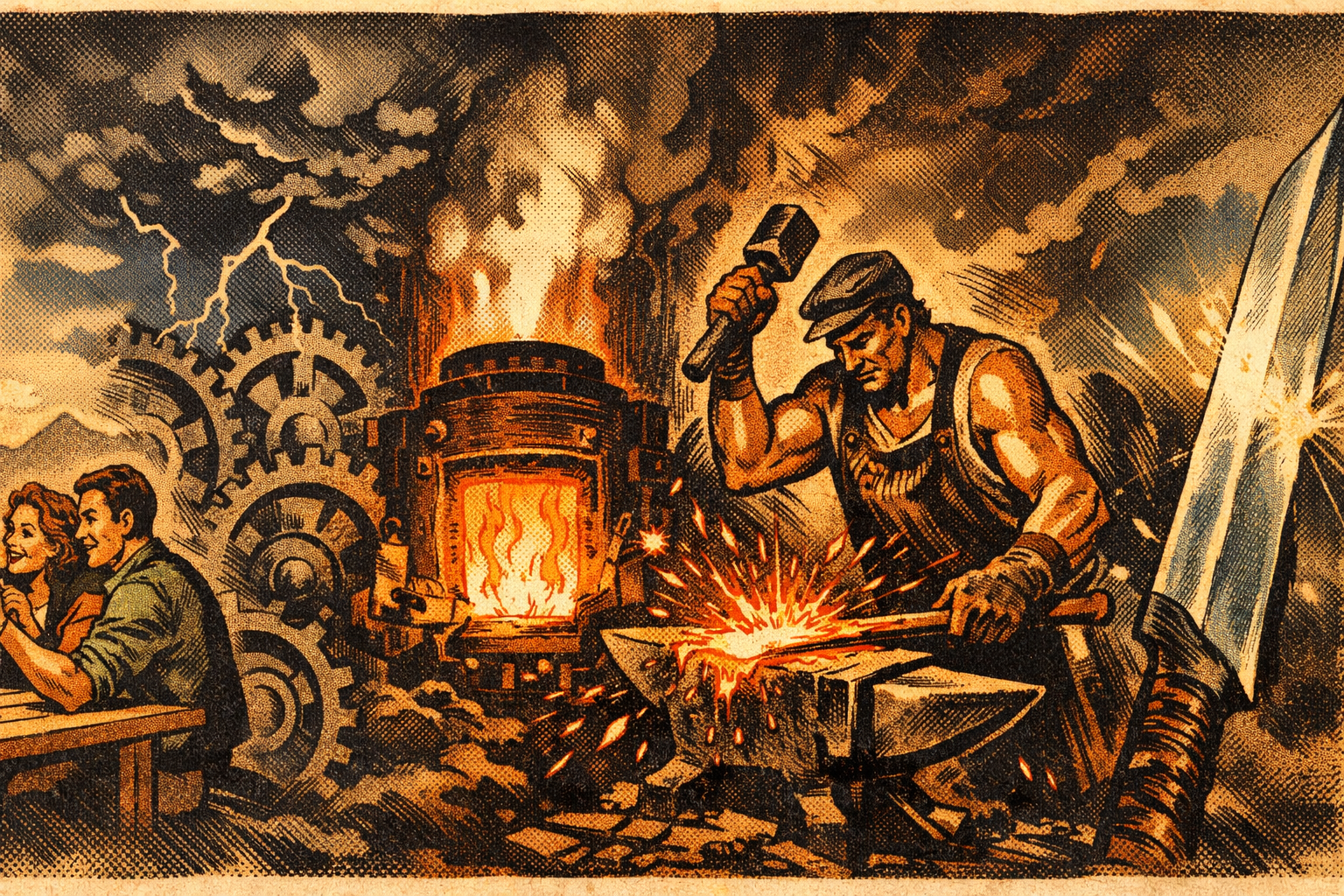
When Life Starts Asking Hard Questions
A man can sit down and write a beautiful vision for his life.
Many people do.
But life does not read vision statements.
Life responds with pressure.
Deadlines at work. Arguments that don’t resolve cleanly. Long weeks where exhaustion replaces enthusiasm. Temptations that slowly erode discipline. The quiet drift that happens over years if no one is paying attention.
Those are the forces that reveal whether a vision is just inspiring language or something sturdy enough to hold weight.
Recently a close friend shared something personal with me: a creed he wrote describing the life he intends to build.
Not a list of goals.
More like a portrait of the man he hopes to become.
And there is a lot in it worth respecting.
The Life He Wants
One passage stood out immediately:
“Living a fun life is a joyous journey, filled with regular gatherings with loved ones, exciting travels, thrilling adventures, and the simple pleasure of laughter.”
You can learn something important about a person from a sentence like that.
This man is not trying to build a life defined by stress and constant struggle. He wants joy. Shared experiences. Energy. A life where laughter shows up often.
That instinct matters.
A lot of men go the opposite direction. They stack responsibility after responsibility until their days are full of obligation and very little enjoyment. Over time resentment starts to creep in. The life they built begins to feel like a burden they can’t escape.
My friend clearly wants something different.
But there’s a challenge hidden inside that vision.
Life tends to push back on joy.
Schedules fill up. Travel becomes complicated. Energy fades after long weeks. The things that once felt spontaneous begin to require effort.
Which raises an uncomfortable question:
What keeps that kind of life alive once the novelty wears off?
The Fire That Has to Stay Lit
In the framework I use, the 3F Mindeset, that question lives inside what I call the Furnace.
More specifically, the Hearth.
Every furnace needs a place where the fire lives. That core heat source powers everything else in the system.
For a person, the hearth is meaning.
It’s the internal reason effort feels worthwhile.
When my friend writes about living life fully and intentionally, he’s pointing to that fire. Without it, joy slowly becomes something people postpone. They assume there will be time later.
Later has a way of disappearing.
So the hearth matters more than most people realize. If that fire goes out, the rest of the structure eventually cools with it.
Where Inspiration Turns Into Discipline
Another part of his creed shifts the conversation from inspiration into something more concrete.
He writes:
“Healthy living looks like being on a constant journey of mental and physical betterment… eating well, regular exercise, prioritizing my medical needs, getting sufficient sleep… meditation… personal development.”
This is where the vision becomes practical.
Health isn’t described as a vague value. It shows up as behavior.
In furnace terms, this is the blower system.
Fuel alone doesn’t keep a furnace burning hot. Airflow does. Oxygen pushes the fire to life again and again.
In a man’s life, discipline plays that role.
Movement. Sleep. Training. Reflection.
These things may look ordinary from the outside, but they keep the internal system functioning when stress arrives.
And stress always arrives.
When life gets heavy, habits like these are what keep the fire from slowly suffocating.
The Complicated Reality of Connection
Another section of the creed focuses on relationships.
He writes:
“Living a connected life is about being a creator of connections… the surprise, the smile, the listening ear, the guidance, or the love someone needed and did not expect.”
There’s something powerful in that idea.
He doesn’t want to simply enjoy relationships. He wants to help create them.
But relationships are also where life produces some of its sharpest friction.
People misunderstand each other. Expectations get tangled. Effort isn’t always returned equally.
This is where a lot of generous men burn out. They give endlessly without protecting themselves.
My friend seems aware of that risk.
He writes about balancing service to others with attention to his own needs.
That balance is crucial.
The Boundaries That Protect the Fire
In furnace design, the walls are lined with something called refractory material.
Its job is simple: protect the structure from melting under extreme heat.
Without that lining, the system destroys itself.
In a person’s life, those protective layers look like boundaries and standards.
Serve people. Support them. Offer generosity.
But don’t erase yourself in the process.
One line from his creed captures that idea clearly:
“If the relationship cannot meet this standard, I will exit cleanly, respectfully, and without drama protecting both my integrity and my future.”
That sentence carries weight.
There’s no anger in it. No bitterness. Just clarity about what he will and won’t tolerate.
Healthy boundaries protect the fire instead of letting it burn the whole structure down.
The Vision of Freedom
The creed also reveals ambition.
He describes a career that would be:
“free from the limitations of time or location while supporting the growth of others in business and life.”
Freedom. Entrepreneurship. Contribution.
Those are powerful motivations.
But anyone who pursues freedom eventually learns the same lesson.
Vision alone doesn’t produce it.
Work does.
The Forge Where Capability Is Built
In the 3F Mindset, this stage belongs to the Forge.
Ideas meet reality here.
And reality has a hammer.
Every day the same forces show up:
Practice. Repetition. Failure. Adjustment. Improvement.
This is where capability forms.
Vision can describe the life someone hopes to live.
But the forge shapes the person capable of living it.
That’s the part many people underestimate.
A Vision Is Only the Beginning
Reading my friend’s creed, one thing becomes obvious.
The values are already there.
He cares about joy. Health. Connection. Integrity. Contribution. Family. Friendship.
Those are strong materials.
But life will eventually test every one of them.
Travel will compete with responsibility. Entrepreneurship will collide with financial pressure. Friendship will compete with time. Love will collide with ego. Health will run headfirst into fatigue.
The creed points the direction.
The next step is making sure the structure can survive friction. Below are the steps I would take to add stability.
Strengthening the Vision
A vision becomes stronger when it begins describing the cost of the life it imagines.
Take the line about living a joyful life with travel, gatherings, and laughter.
That’s the outcome.
But outcomes only exist because someone protects them.
As adulthood grows more complicated, joy stops appearing on its own. Someone has to create it deliberately.
That means planning time with friends. Protecting space for family. Initiating experiences instead of waiting for them.
Joy rarely survives by accident.
Turning Ideals Into Behavior
Another step is translating values into visible actions.
For example, my friend writes that his friendships should be open, reciprocal, and honest.
Those are good aspirations.
But friendships are built through small, repeated choices.
Reaching out first. Showing up when someone needs support. Speaking honestly when something feels off.
Those moments are the hammer strikes that shape the relationship over time.
Building a Career Around Mastery
His career vision focuses on freedom and helping others succeed.
That’s a strong direction.
But sustainable freedom usually grows out of mastery.
At some point the questions become practical.
What problems do you solve? What skill are you sharpening? Where are you becoming unusually capable?
Lifestyle tends to follow craftsmanship, not the other way around.
The forge rewards people who commit to building a real edge.
The Standards That Shape Identity
One of the strongest elements already present in the creed is the presence of standards.
The line about leaving relationships respectfully if they fall below a certain standard shows that clearly.
More statements like that would strengthen the whole structure.
Things like:
- I don’t avoid difficult conversations.
- I protect my health even when work is demanding.
- I refuse dishonesty in my relationships.
Standards create edges. And edges shape identity.
The Man the Vision Requires
Right now the creed paints a vivid picture of a life.
The final step is describing the man required to live it.
Because the life itself isn’t the true creation.
The man is.
Statements like these begin to clarify that identity:
- A man who tells the truth even when it costs him.
- A man who creates connection wherever he goes.
- A man who leaves people stronger than he found them.
- A man who does hard things consistently.
Once that identity becomes clear, decisions simplify.
The question stops being “What should I do?”
It becomes: “What would that man do?”
And the answer usually shows up quickly.
When Vision Meets Reality
My friend has already done something most people never attempt.
He stopped drifting long enough to think carefully about the life he wants to build.
That alone puts him ahead of the crowd.
The next step is simply deepening the structure.
Add the cost. Add the behaviors. Add the standards. Clarify the man.
When those pieces lock into place, something interesting happens.
The creed stops feeling like a document.
It starts functioning like a system.
And systems produce results.
The Only Rule That Matters
At that point the path becomes surprisingly simple.
Live the creed.
Or don’t.
But if you choose the life you described, there’s really only one rule that matters.
You have to earn it.
Every day.
Because visions don’t become real when they’re written.
They become real when they survive pressure.
And life is very good at applying heat.
Applying the Fire–Furnace–Forge Framework
Below is a fortified version of his vision. The exercise was not to change his values, but to forge them into a structure that can withstand pressure.
The structure works like this:
- Fire — Why this life matters. The animating purpose.
- Furnace — The disciplines and behaviors that sustain the life.
- Forge — The standards that shape decisions and protect the life.
Fire — The Life I Am Here to Build
I am here to live a life that is fully engaged, deeply connected, and built with intention.
My life is not something that simply unfolds around me. It is something I create through the way I show up each day with presence, courage, curiosity, and responsibility.
I believe life is meant to be experienced with energy and gratitude. I seek adventure, laughter, travel, and meaningful gatherings with the people I love. Joy is not accidental in my life. I create it intentionally, even when life is demanding.
I believe health is a lifelong commitment. I pursue mental, physical, and spiritual well-being so that I can show up fully for the life I am building. I take care of my body, sharpen my mind, and create space for reflection, recovery, and growth.
I believe connection is one of the most powerful forces in the human experience. I choose to be someone who brings people together. I create spaces where people feel seen, heard, and supported. I offer encouragement, guidance, humor, and presence when it is needed most.
In love, I build a partnership grounded in emotional safety, honesty, mutual growth, and shared responsibility. I choose relationships that are reciprocal, emotionally mature, and anchored in truth. My partner and I support each other’s healing, growth, and purpose while choosing each other freely, not from fear or dependency.
In my work, I pursue freedom through entrepreneurship and creation. I build systems, opportunities, and value that allow me to grow financially while helping others grow in their businesses and their lives. My success creates freedom not only for myself but also for the people I serve.
My family life is rooted in trust, patience, accountability, and unconditional support. Our home is a place where communication is open, laughter is frequent, mistakes are forgiven, and growth is encouraged.
My friendships are built on honesty, loyalty, accountability, and shared growth. The people closest to me challenge me, support me, and walk beside me as we each strive to become stronger versions of ourselves.
Through the way I live, I aim to leave people and places better than I found them. I demonstrate vulnerability, compassion, accountability, and empathy so that others feel permission to live more openly and courageously themselves.
Furnace — The Disciplines That Sustain This Life
The life I want does not happen by accident. It is sustained through consistent behavior.
I maintain my health through disciplined care of my body and mind. I move regularly, eat intentionally, sleep sufficiently, and invest in practices that restore my energy and clarity.
I invest time in relationships that matter. I initiate gatherings, reach out to people I care about, and show up consistently for the people in my life. Connection is something I actively cultivate.
I communicate openly and honestly in my relationships. When conflict arises, I address it directly rather than avoiding it. I listen with curiosity and speak with clarity.
I pursue meaningful work with focus and discipline. I seek opportunities aligned with my values and long-term vision. I continue learning, building, and improving so that my work becomes more impactful and financially rewarding over time.
I make space for reflection and solitude. Through meditation, journaling, and quiet time, I examine my thoughts, emotions, and actions so that I continue growing rather than drifting through life unconsciously.
I create joy intentionally. I plan experiences, travel, and adventures that enrich my life and strengthen the bonds with the people around me.
I practice gratitude and perspective, reminding myself regularly of the privilege of being alive and the responsibility of using my life well.
Forge — The Standards That Shape My Life
My life is protected and shaped by the standards I hold myself to.
I tell the truth, even when it is uncomfortable.
I do not abandon my needs, values, or integrity in order to maintain connection or approval.
I address problems directly rather than avoiding difficult conversations.
I take responsibility for my behavior, my growth, and the direction of my life.
I protect my physical and mental health, recognizing that my well-being determines the quality of every other area of my life.
I choose relationships that are reciprocal, respectful, and emotionally mature. I do not tolerate dishonesty, chronic avoidance, instability, or disrespect as the cost of connection.
If a relationship cannot meet the standards of honesty, safety, and mutual effort, I step away cleanly and respectfully.
I surround myself with people who pursue growth, accountability, and authenticity. I encourage them, challenge them, and allow them to challenge me in return.
In my work, I pursue opportunities that align with my values and long-term vision. I do not chase success that requires me to compromise who I am.
I measure success not only by what I achieve but by the way I live, how I treat people, how I grow through difficulty, and how much good I leave behind.
Full Responsibility
The life I want is not guaranteed.
It must be created, protected, and reinforced through the choices I make every day.
Joy requires intention.
Connection requires effort.
Health requires discipline.
Love requires courage.
Freedom requires responsibility.
If I want this life, I must live in a way that continually earns it.
And that work begins again every day.