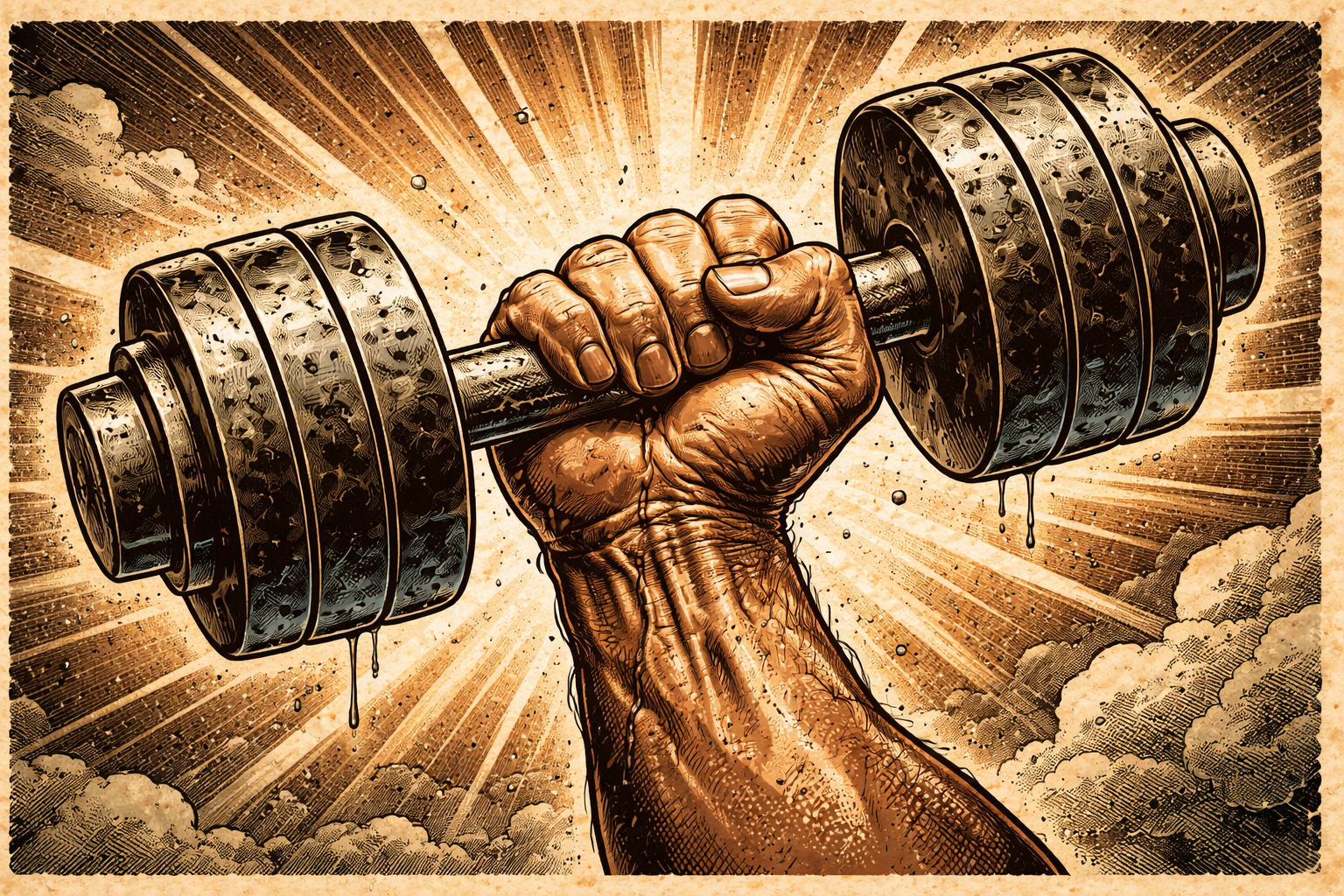
The modern tendency is to treat physical training as a lifestyle accessory. It is framed as self improvement, aesthetic preference, or optional hobby. You lift if you care about fitness. You run if you enjoy it. You eat well if you are health conscious.
This framing misses something deeper. Physical discipline is not merely about appearance or longevity. It is about authority, first over oneself and then in the world.
A man’s relationship to his body forms the foundation of his confidence, his mental steadiness, and his capacity to endure pressure. When the body is neglected or treated casually, the self becomes negotiable. When the body is trained consistently, the self becomes reliable.
The body is the base layer of human experience. Every demand, whether intellectual or emotional, is filtered through physical energy. Fatigue narrows patience. Poor diet clouds focus. Chronic undertraining erodes resilience. Conversely, strength, endurance, and adequate rest expand what feels possible.
To train the body is to stabilize the platform on which every other ambition stands.
Why Physical Discipline Shapes the Mind
When someone chooses to lift weight that strains his muscles, to run despite discomfort, or to rise early to train, he is practicing a specific skill: voluntary exposure to controlled friction. He is teaching himself that discomfort is survivable, that effort produces adaptation, and that promises made to oneself can be kept.
Psychologists often describe confidence as a belief in one’s ability to handle future challenges. That belief does not arise from positive thinking alone. It arises from repeated evidence. Every completed workout, every clean meal chosen over convenience, every consistent bedtime becomes a data point. The message accumulates: I do what I say I will do.
This is why pushing through the last repetition in a set often feels disproportionally meaningful. The weight itself is trivial in the grand scheme. What matters is the refusal to quit early. That refusal becomes a transferable skill. It shows up in difficult conversations, in long projects, in moments when retreat would be easy.
Physical training, done consistently, is a rehearsal for life under strain.
Nutrition and sleep operate the same way. Choosing to fuel the body deliberately rather than impulsively is a daily assertion of long term thinking over short term comfort. Establishing a consistent sleep pattern is a commitment to performance over distraction. These habits appear mundane. In aggregate, they construct a person who is less reactive and more deliberate.
None of this requires elite athleticism. It requires structure.
Fixed training days. Defined goals. A basic standard for food. A regular time to sleep. Without structure, effort becomes sporadic and identity remains unstable. With structure, the body becomes a steady base, an anvil on which character is shaped.
A Comfortable Myth
The belief that mental strength can be developed independently of physical habits leads to considering physical training as secondary, even superficial. Following this, one can be thoughtful, strategic, and emotionally mature without lifting weights or tracking protein intake. Many brilliant and accomplished individuals are not visibly athletic. There is truth here. Physical prowess does not guarantee wisdom, kindness, or leadership. Muscles are not morality.
The problem with this is that the body can not be ignored without consequence. The mind can not operate at peak capacity while the body is undertrained, under rested, and poorly fueled. Even the most cerebral work depends on energy regulation, stress tolerance, and sustained focus. These are physiological as much as psychological capacities.
Moreover, men who swear physical training is optional are often masking avoidance. It is easier to discuss mindset than to endure discomfort. It is easier to read about resilience than to run when the air is cold and the legs are heavy.
The belief that mental strength will be enough is appealing because it allows one to bypass the daily friction of physical discipline. It promises growth without sweat. In practice, it produces fragility. Under real stress, the body falters first, and the mind follows.
Strength as a Civic and Personal Responsibility
Reconsidering physical discipline as foundational rather than decorative changes its meaning. Exercise is no longer about chasing an ideal body. It becomes a form of preparation. Nutrition is no longer about dieting. It becomes fuel management. Sleep is no longer indulgence. It becomes strategic recovery.
A stronger body supports broader obligations. A father who trains consistently models commitment. A leader with stable energy makes steadier decisions. A partner who manages stress through exercise is less likely to discharge it destructively at home.
The implications extend beyond the individual. A culture that treats physical neglect as normal gradually lowers its tolerance for discomfort. It becomes less patient, less durable, more reactive. The habits formed in private bodies ripple outward.
The gym in the early morning is not filled with men chasing aesthetics. It is filled with men deciding, quietly, whether they will be reliable under pressure. Each repetition is a vote for steadiness over softness. Each structured week of training is a refusal to remain negotiable.
A man’s physical discipline is the base of his authority. It shapes not only his body, but his confidence, his endurance, and his ability to meet the demands of his life.
The choice is not between being an athlete or not. It is between being structured or being reactive. The body will either be treated as a liability that drains energy or as a foundation that supports it.
In the end, the most important negotiations are the quiet ones. They happen before dawn, before breakfast, before anyone is watching. They determine whether a person will carry himself with steadiness or with apology.
The body keeps the score.