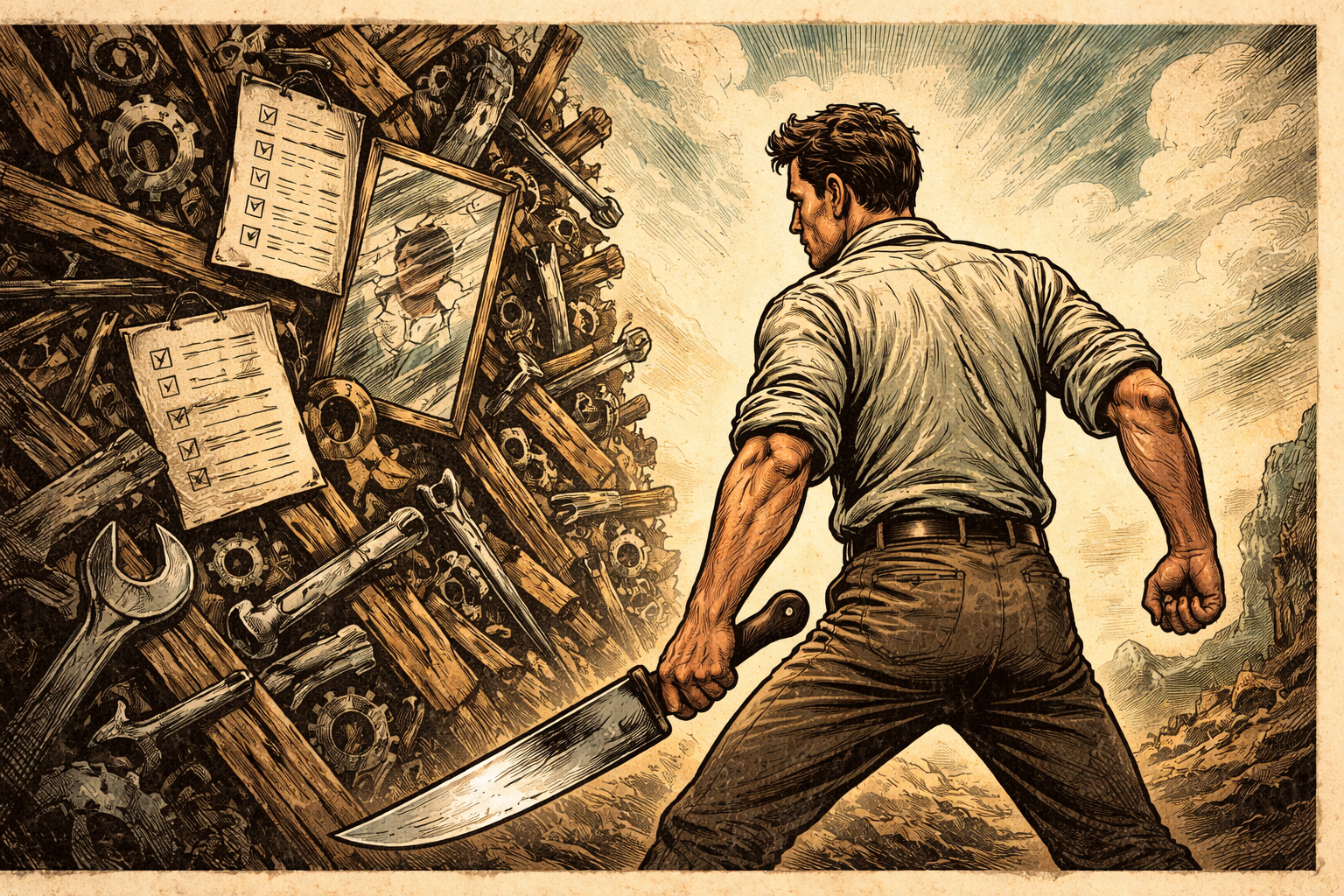
The Man Who Tries to Fix Everything
He sits at his desk long after the others leave, staring at a list of what needs work. Improve communication. Get better at sales. Be more patient. Learn new software. Wake up earlier. Stop procrastinating. The list grows each week, and with it, a quiet sense that he is always behind.
He is not lazy. He works hard. He reads books. He listens to podcasts. He signs up for courses. But most of his effort feels like repair. He is sanding rough spots, patching cracks, correcting flaws. The better he becomes at spotting his weaknesses, the more weaknesses he seems to find.
Meanwhile, someone else in the office moves forward with less strain. That person does not seem balanced or perfect. In fact, he has obvious gaps. But he has one thing that cuts clean. When pressure rises, he leans into what he does best. And somehow, that is enough to make progress visible.
The first man assumes he needs to become more complete. The second behaves as if he needs to become more precise.
Why Most People Stay Stuck Improving the Wrong Things
The deeper problem is not laziness or lack of discipline. It is misdirected effort. Many capable people are trapped in a cycle of self correction because they believe growth means fixing what is weak before using what is strong. This belief is widely accepted and quietly destructive.
Real progress does not come from rounding yourself out. It comes from sharpening what already works and placing it where it matters. When people ignore their strengths and obsess over their weaknesses, they dilute their impact and stall their identity. When they identify and deliberately use their strengths, effort multiplies and direction clarifies.
This is not a motivational claim. It is an interpretive one. It explains why hard working individuals often feel stalled, and why others with visible flaws can move ahead. The difference is not total ability. It is leverage.
To understand this, we have to look at how people are trained to think about competence.
The Culture of Self Correction

From school onward, most evaluation systems are built around deficits. A student who excels in writing but struggles in math is told to focus on math. An employee who closes deals but struggles with organization is urged to fix organization first. Performance reviews highlight what needs improvement more than what creates results.
This makes sense in theory. A chain is only as strong as its weakest link. But individuals are not chains. They are tools. And tools are designed for specific uses.
A hammer is useless for cutting wood. A knife is useless for driving nails. Asking each tool to compensate for its weaknesses misses the point. What matters is whether it is placed in the right context for its strength.
Research in positive psychology has repeatedly shown that people who use their strengths daily report higher performance and greater engagement. But beyond research, the logic is straightforward. Strength produces energy. Weakness consumes it. When you spend most of your effort in areas of weakness, progress is slow and draining. When you operate inside strength, progress accelerates and reinforces identity.
Consider the man who is naturally analytical. He sees patterns others miss. Under pressure, he becomes clearer, not confused. Yet he spends most of his time trying to become more charismatic because he thinks leadership requires it. He improves slightly, but always feels strained. Meanwhile, his analytical skill, which could shape strategy or solve complex problems, sits underused.
Or think of the man who connects easily with others. People trust him. He reads emotional cues well. But he believes real value lies in technical expertise, so he avoids roles that require empathy. He studies systems he does not enjoy and wonders why he feels mediocre.
In both cases, the issue is not lack of potential. It is refusal to lean into what already cuts clean.
Identity Is Built on Repeated Use
Strengths do more than produce results. They shape identity. When a person repeatedly uses a core strength, two things happen. First, outcomes improve. Second, self perception stabilizes. He begins to see himself clearly.
Clarity of identity reduces hesitation. A man who knows he is reliable under pressure does not panic when stakes rise. A man who knows he can communicate complex ideas simply does not shy away from hard conversations. Each use of strength sharpens both skill and self concept.
This is why leverage matters. It is not only about output. It is about internal coherence. When strengths are named and deployed, the gap between who you are and what you do narrows. Life feels less scattered.
By contrast, constant self correction keeps identity unstable. You are always becoming, never arriving. Always fixing, never using. The mind stays focused on what is missing, not on what is effective.
Over time, this breeds frustration. You work harder but feel less defined.
The Seduction of Well Roundedness
There is, of course, an objection. Focusing on strengths can sound like arrogance or avoidance. Should we not strive to be balanced? Is it not dangerous to ignore weaknesses?
This objection appears reasonable because it confuses neglect with prioritization. To sharpen a strength is not to deny a weakness. It is to choose where the majority of your effort goes.
Weaknesses that block basic functioning must be addressed. If a pilot cannot land a plane safely, he must fix that. But once competence is secured, progress does not come from obsessing over minor deficits. It comes from doubling down on what differentiates him.
The ideal of the well rounded person is often misunderstood. In practice, those who stand out in any field are not evenly skilled. They are uneven in powerful ways. They have edges. Their weaknesses may remain visible, but their strengths dominate the field.
History offers countless examples. Great leaders were often flawed in temperament but decisive in crisis. Innovative thinkers were socially awkward but relentlessly curious. Elite athletes are rarely average at everything. They are exceptional in specific capacities that define their role.
The belief that we must eliminate every weakness before using our strengths keeps many people in preparation mode indefinitely. They wait until they are complete. They never act from their edge.
Precision Over Perfection
If progress is driven by leverage, then the task is not endless self improvement. It is precision.
Precision begins with naming strengths clearly. Not vague traits like good person or hard worker, but specific capacities that produce results. Analytical thinking. Physical endurance. Calm under stress. Strategic planning. Persuasive communication. Deep empathy.
The next step is evidence. Where has this strength already worked? When did it solve a problem? When did others rely on it? Anchoring strengths in real examples removes doubt. It shifts identity from hopeful to factual.
Then comes placement. A strength unused is potential wasted. The analytical mind must be given complex problems. The empathetic man must be placed where trust is needed. The physically strong must test that strength against resistance. Deployment sharpens the edge.
This process does not make a person perfect. It makes him effective.
Effectiveness, repeated over time, builds reputation. Reputation reinforces identity. Identity shapes future choices. The cycle compounds.
The Cost of Staying Blunt

Return to the man at his desk, staring at his list of flaws. His effort is real. His discipline is real. But his strategy is flawed. By trying to fix everything at once, he spreads himself thin. He becomes competent in many areas, exceptional in none.
The alternative is not complacency. It is concentration. Identify what already works. Strengthen it. Use it where it matters. Allow results to define you.
Real progress does not come from rounding yourself out. It comes from sharpening what already works and placing it where it matters. When people ignore their strengths and obsess over their weaknesses, they dilute their impact and stall their identity. When they identify and deliberately use their strengths, effort multiplies and direction clarifies.
This shift has implications beyond personal growth. Organizations that place people according to strengths outperform those that treat roles as interchangeable. Communities thrive when individuals bring distinct edges instead of uniform mediocrity. Even culture benefits when uniqueness is refined rather than flattened.
The man who stops trying to fix everything does not become careless. He becomes precise. He knows what cuts. He brings it forward. Over time, the world responds to that edge.
Perfection remains distant. Impact does not.
And in the end, impact is what shapes a life.