
A man sits at his kitchen table long after the house has gone quiet. The dishes are done. His phone is face down. Tomorrow’s obligations are already lining up in his head. He tells himself he is tired. That is true. He tells himself he will start fresh next week. That is also familiar.
If pressed, he could list his goals. He wants to lead better at work. He wants to be more present at home. He wants to get back in shape, to take risks he once talked about. He has read enough books to know what discipline looks like. He has listened to enough advice to understand what confidence sounds like.
And yet, when a moment comes that demands decision, something quieter speaks first. It says, This is just who you are. It says, Do not overreach. It says, Stay in your lane. He rarely notices that voice. He simply follows it.
Most lives are not limited by lack of knowledge. They are limited by an unexamined narrative.
The Story That Governs Action
Men do not live primarily by their goals, but by the story they believe about themselves. That story, often inherited and rarely revised, shapes behavior more powerfully than intention ever could.
This is not a poetic metaphor. It is a practical observation. A man who believes he is unreliable will hesitate before committing. A man who believes he is unlucky will see risk as confirmation of fate. A man who believes he is average will quietly decline opportunities that demand boldness. In each case, the behavior appears rational. Underneath it sits a story.
Psychologists have long noted that identity precedes action. People act in ways that confirm who they think they are. When behavior and identity clash, identity usually wins. A smoker who still sees himself as a smoker struggles to quit. An athlete who sees herself as disciplined trains even when tired. The narrative does not merely describe the person. It directs the person.
This is why many men feel stuck despite effort. They set goals that conflict with their self story. They try to behave like leaders while still believing they are background characters. They attempt discipline while quietly thinking of themselves as inconsistent. The internal contradiction drains momentum.
The problem is not laziness. It is misalignment.
Inherited Scripts and Quiet Obedience
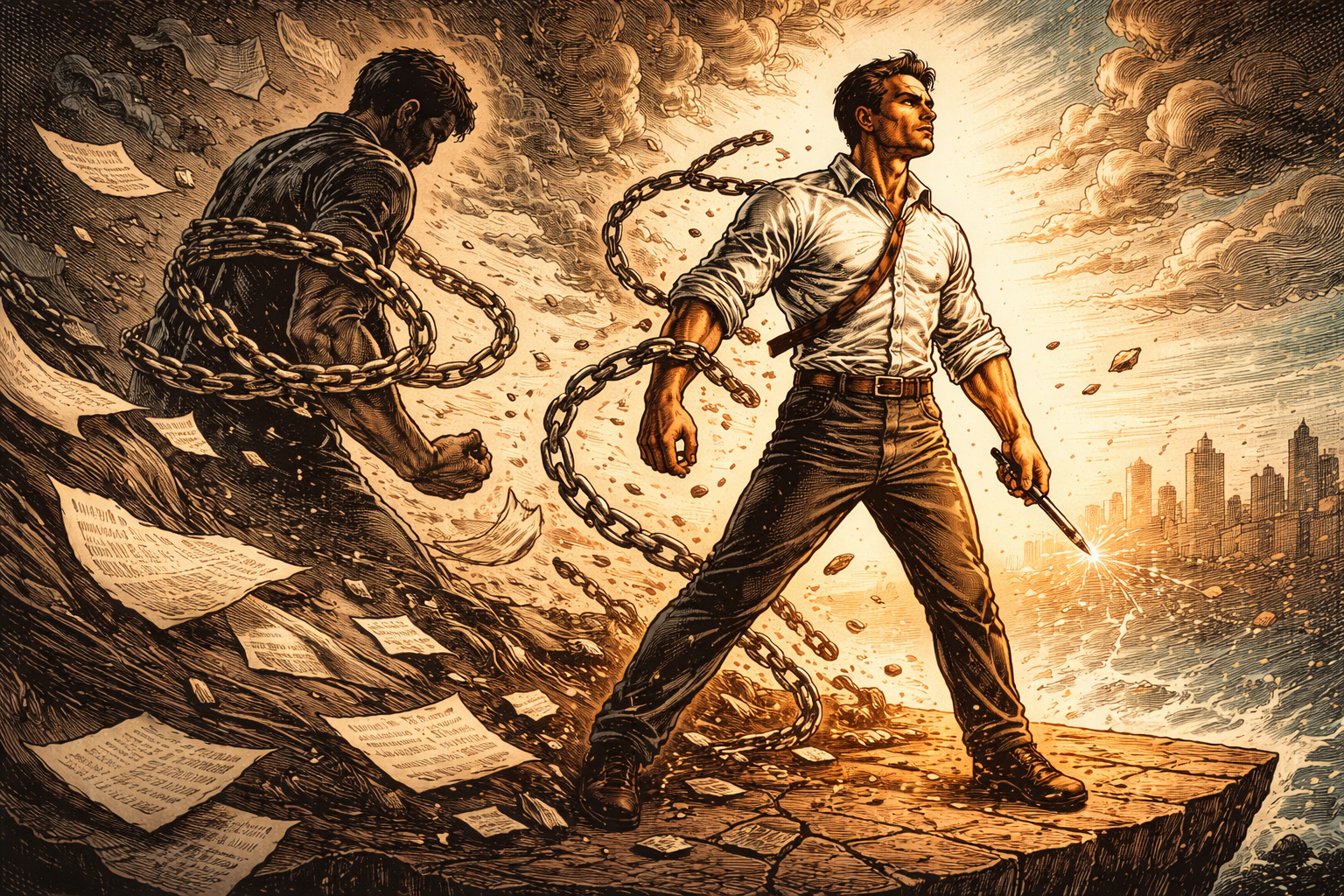
Most personal narratives are not consciously chosen. They are absorbed. A boy grows up hearing that men in his family do not finish what they start. Or that they must not show weakness. Or that success belongs to other kinds of people. These ideas settle into memory and then into identity.
Society adds its own lines to the script. Stay realistic. Do not embarrass yourself. Be grateful for what you have. None of these statements are false in isolation. But when woven into a fixed identity, they narrow what feels possible.
Past failures harden the script further. A business collapses. A marriage ends. A promotion goes to someone else. The event becomes explanation. I am not cut out for this. I always mess it up. I am not leadership material. Over time, these conclusions stop feeling like interpretations. They feel like facts.
The result is quiet obedience to a story that was never examined.
This obedience shows up in small ways. Not speaking up in meetings. Avoiding hard conversations. Settling for incremental improvement instead of structural change. Each choice reinforces the narrative. The story grows stronger because it keeps being proven.
It is easy to mistake this pattern for personality. In reality, it is authorship by default.
Why Positive Thinking Is Not Enough
At this point, an objection often surfaces. Is this not just positive thinking dressed up in serious language? Are we simply telling men to imagine a better version of themselves and hope it sticks?
The answer is no, and the difference matters.
Positive thinking tries to override reality with optimism. It asks a man to repeat affirmations that may not yet be earned. It avoids the weight of past experience. That approach often fails because it does not respect evidence.
Rewriting a personal narrative, by contrast, is not about denying the past. It is about reinterpreting it. The same event can function as proof of inadequacy or as proof of endurance. The same failure can signal incapacity or training. The facts remain. The meaning shifts.
Consider the difference between two statements
- I failed because I am not capable.
- I failed because I attempted something difficult and learned where I am weak.
Both describe the same event. Only one allows forward motion.
The work, then, is not fantasy. It is classification. It asks a man to decide what his past is for.
This reframing also demands specificity. A vague declaration, I am a strong man, has little force. A concrete statement, I am a man who keeps commitments even when uncomfortable, has behavioral implications. It can be tested. It can be proven. It can also be disproven. That is the point.
A narrative worth living by must be anchored in values and followed by action. Otherwise, it is decoration.
Narrative as Strategy
Once understood this way, a personal narrative becomes strategic. It aligns belief with direction. It reduces internal friction. It clarifies decisions under pressure.
When a man states clearly, I am becoming someone who leads with integrity, certain options close immediately. Cutting corners becomes harder to justify. Avoiding responsibility feels inconsistent. The story functions as both shield and sword. Shield, because it protects against external labels. Sword, because it cuts away behaviors that no longer fit.
Over time, repeated action in alignment with the new story strengthens identity. The narrative stops feeling aspirational and starts feeling accurate. This is how transformation becomes durable.
Without this step, growth efforts scatter. A man reads, trains, sets goals, and attends seminars. Yet when tested, he defaults to the old script. He has gathered tools but never chosen the role he intends to play.
The deeper implication extends beyond individual success. Families, teams, and communities are shaped by the stories their members carry. A man who sees himself as responsible behaves differently at home and at work. A man who sees himself as perpetually sidelined withdraws in both spaces. Personal narrative is private, but its consequences are public.
The Responsibility of Authorship

Men live by the stories they believe about themselves, and unless those stories are examined and rewritten, they will continue to shape behavior more than any stated goal.
This is not an argument for self invention without limits. It is an argument for conscious authorship within the boundaries of reality. The past cannot be erased. It can be interpreted. Values cannot be borrowed. They must be named. Purpose cannot be improvised daily. It must be articulated.
The act of writing an origin story is less about creativity and more about commitment. It is a declaration that the past will serve the future, not dictate it. It is a decision to align belief with chosen values rather than inherited labels.
In the end, the kitchen table remains the same. The obligations still line up. The phone still rests face down. What changes is the voice that speaks first when a decision appears. Instead of saying, This is just who you are, it says, This is who you are becoming.
That shift, quiet as it is, alters the trajectory of ordinary days. And ordinary days, accumulated, form a life.