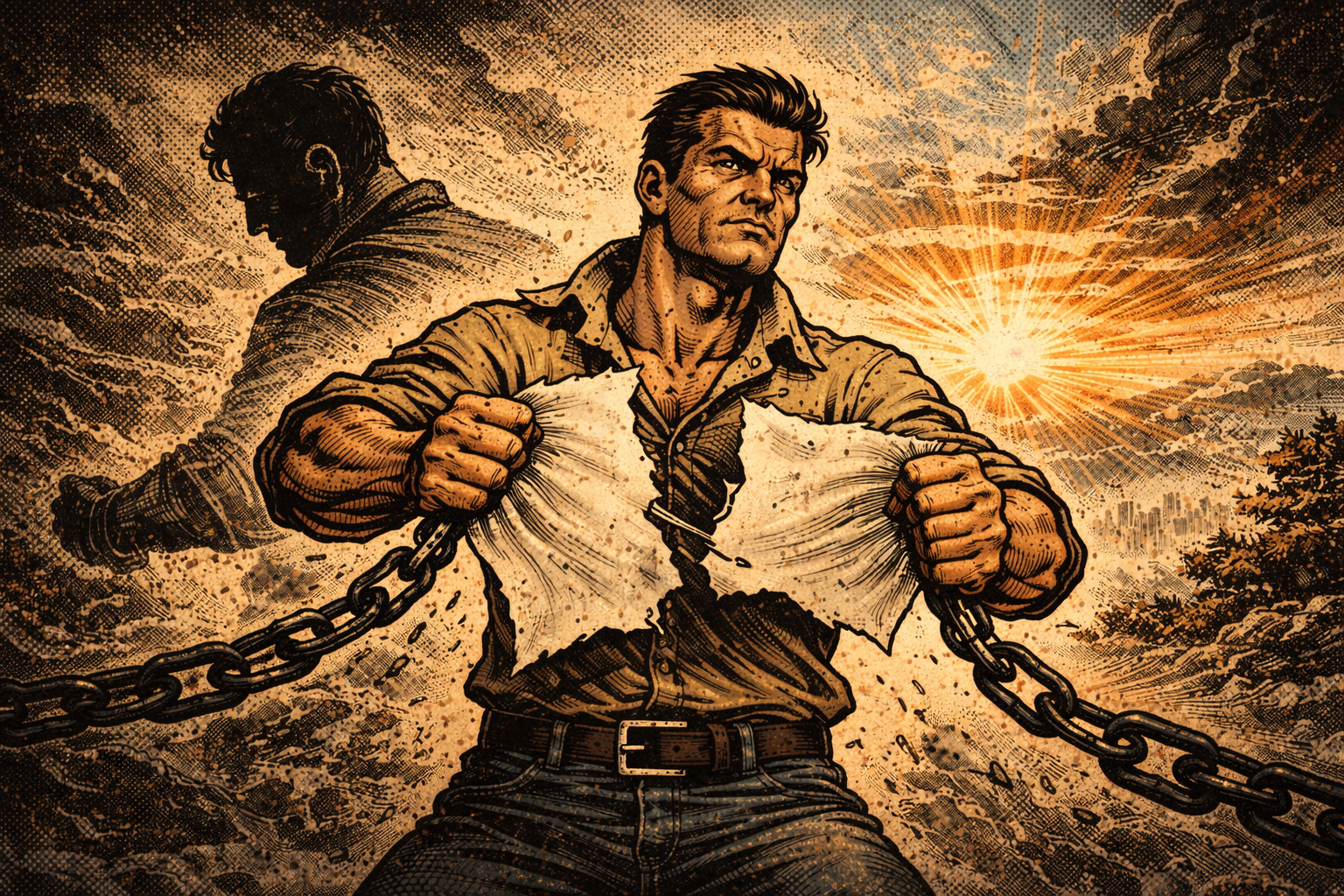
Change the script you live by, and your actions start changing on their own.
The Weight You Wake Up With
Most mornings begin the same way. You wake up already negotiating with yourself—about whether today is the day you finally act, or just another day you explain why you couldn’t. Nothing dramatic happens. No crisis. No failure large enough to justify the weight you feel. Just a familiar drag, like walking with a hand subtly pressing between your shoulder blades. You move through the day competently enough. From the outside, it looks fine. From the inside, it feels stalled.
For a long time, we’re taught to treat this feeling as a motivation problem. If only you were more disciplined. More confident. More committed. But that explanation never quite fits, because you do work hard. You do care. And yet the same hesitations show up, the same decisions get delayed, the same mistakes quietly repeat.
The Invisible Script Making Your Choices
What’s actually happening is simpler—and harder—than a lack of willpower. You are living inside a story you did not consciously choose, and that story is making decisions on your behalf.
Most men carry an internal script that explains who they are and what is reasonable to expect from life. It often forms early, shaped by family roles, early failures, or long stretches of being overlooked. I’m the one who plays it safe. I’m dependable, but not the guy who takes the lead. I had bad breaks. The story feels factual because it accounts for the past. But stories are not neutral descriptions. They are operating systems.
Your behavior is loyal to the story you believe about yourself.
Why Belief Shows Up as Behavior Under Pressure
The story you believe tells you what risks are allowed, how much effort makes sense, and how you behave when pressure hits. If your story frames you as damaged, effort feels pointless. If it frames you as passive, decisive action feels unnatural. If it frames you as small, ambition feels dishonest.
A man becomes what he believes himself permitted to be. Not because of mysticism, but because belief determines behavior when there is no time to think. Under pressure, you don’t rise to your goals—you default to your identity.
This is why change so often stalls at insight. You can understand your values, name your frustrations, even feel real anger about wasted time—and still stay stuck. Without a channel, that energy leaks. Reflection turns into rumination. Motivation burns hot and then cools into the same shape it had before.
Where Insight Dies Without a Channel
Think of insight like molten metal. Powerful, unstable, full of potential. If it has no path to run, it pools, hardens, and becomes useless weight. Your personal narrative is the cast that gives that heat a form. It takes what you’ve lived through and decides what it means—and therefore what it is for.
Most men fail here in one of two ways. They endlessly analyze the past, hoping clarity alone will free them. Or they fantasize about a future self with no grounding in who they’ve actually been. Both approaches collapse under pressure. The first never decides. The second shatters when reality pushes back.
Rewriting your personal narrative is neither therapy nor affirmation. It is reassessment. You are not inventing a new past; you are reclassifying it.
Turning the Past Into Fuel Instead of Proof
What once served as evidence of limitation becomes proof of training. What looked like delay becomes preparation. What felt like damage becomes pressure with a purpose.
The old script explains why you stalled.
The new script explains why you move.
Once written, that story starts doing quiet, practical work. It changes how fast you decide because you are no longer renegotiating who you are. It changes how you act under stress because your role is already defined. Others respond differently not because you announce a transformation, but because consistency reads as confidence.
This is how momentum actually begins—not with force, but with coherence.
The One-Page Declaration
Write a one-page origin story. One page only. No polishing. No performance.
First, acknowledge the old script. Write it plainly, even if it’s uncomfortable. The excuses, the labels, the inherited expectations you’ve been living under. Be honest enough that it stings.
Then forge the new story. Reframe past trials as training. Name your values without decoration. State, in clear language, who you are becoming and what your pressure is for. Include your why—family, legacy, conviction, or responsibility. If it doesn’t feel necessary, it won’t hold.
Read it aloud. Anywhere it feels false, don’t soften it—make it truer. Then stop editing. This is not a journal. It is a declaration.
The Chapter Where Momentum Begins
If your life were a film, this would be the chapter where the protagonist stops drifting and starts aiming. The part where doubt doesn’t vanish, but no longer gets a vote. Where decisions come faster because the story already demands them.
You can keep living as a character written by your past, accepting the same frustrations year after year. Or you can take the pen and accept the responsibility that comes with authorship.
No one is coming to revise this for you.
Write the story. Then act like the man it describes.