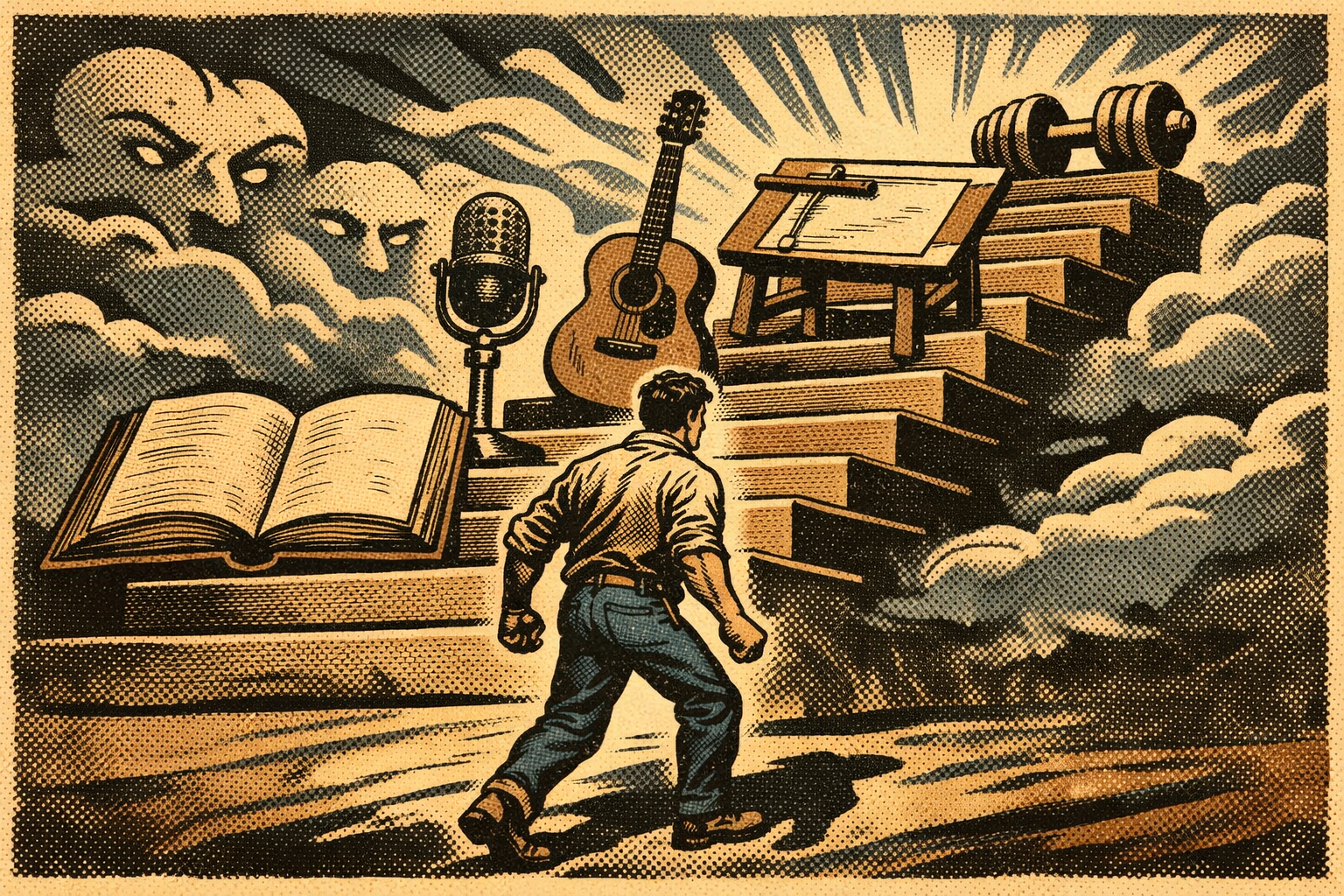
The Quiet Panic of Being New
There is a specific kind of silence that settles over a grown man when he realizes he is the least capable person in the room.
It is not loud humiliation. It is subtler than that. It is the awareness that everyone else seems to know where to stand, what to say, how to move. He adjusts his posture. He laughs a bit too quickly. He nods as if he understands.
Then he does what most adults do when competence is uncertain: he avoids returning.
The beginner’s position, which once defined childhood, becomes intolerable in middle age. We expect children to stumble through piano lessons and miss the ball in Little League. We even find it charming. But somewhere between youth and adulthood, the license to be visibly unskilled expires. In its place grows a quiet rule; If you cannot do it well, do not do it publicly.
This rule shapes more of adult life than we admit.
The Real Barrier to Mastery Is Not Talent but Ego
The central obstacle to mastery in adulthood is not time, not intelligence, and not opportunity. It is the refusal to tolerate being a beginner.
We tend to treat stagnation as a problem of discipline. We tell ourselves that if we simply worked harder, read more books, or woke earlier, we would improve. But the deeper issue is often psychological. Growth requires repeated exposure to inadequacy. It requires correction. It requires visible imperfection.
Many adults would rather protect the image of competence they have built than risk the discomfort of starting from scratch. The result is a quiet plateau. Careers flatten. Hobbies stall. Relationships repeat the same patterns. The external life may look stable, even successful. Internally, something has stopped moving.
To master anything, whether public speaking, parenting, coding, or playing an instrument, one must first accept being bad at it. This is not a motivational slogan. It is a structural fact. Skill develops through repetition under correction. Correction implies error. Error implies visible weakness. Without enduring that sequence, there is no transformation.
The man who believes he already knows enough does not grow. The man who admits he does not yet know enough can.
Why We Stop Being Students

Children do not struggle with beginner’s mind because their identity is not yet fixed. They expect not to know. Adults, by contrast, live inside reputations. By the time a man reaches his thirties or forties, he has built a narrative that he is competent, capable, experienced. That narrative is reinforced by professional titles, social status, and peer comparison.
Starting over threatens that narrative.
Psychologists have long observed that adults often gravitate toward environments where their existing strengths are rewarded. Success becomes self-reinforcing. A manager who excels at strategy will continue seeking strategic roles. A former athlete will keep playing sports he already understands. The familiar terrain offers validation.
The unfamiliar terrain offers exposure.
This dynamic explains why many professionals avoid skill expansion later in life. It is not that they lack interest. It is that learning publicly risks status. In workplaces that prize expertise, asking basic questions can feel dangerous. In social circles that reward confidence, admitting ignorance can feel destabilizing.
The irony is that the very trait we associate with mastery, confidence, is usually built through years of repeated incompetence. The world’s elite performers, from martial artists to entrepreneurs, tend to return to fundamentals long after they have surpassed their peers. They drill basics. They solicit critique. They treat themselves as ongoing students.
Their advantage is not arrogance. It is sustained humility.
The Discipline of Repetition
Skill does not develop from scattered effort. It develops when energy is applied deliberately to a specific weakness, again and again, until change occurs. In craft traditions, this is obvious. A blacksmith does not swing wildly at metal. He strikes the same area repeatedly, shaping it with controlled force. A pianist practices scales not because they are glamorous, but because they refine precision.
In adulthood, we often confuse activity with progress. We watch tutorials instead of practicing. We read about communication instead of initiating difficult conversations. We attend workshops but resist the drills that expose our gaps.
The beginner’s mind restores discipline to repetition. It allows a person to say, “I am here to learn, not to perform.” That shift matters. When performance becomes secondary to improvement, feedback becomes usable rather than threatening. Correction becomes information rather than insult.
This is how energy turns into skill. Not through inspiration, but through repeated, humble application.
The Comforting Myth of “Already Good Enough”
Efficiency matters. Time is limited. Why pour effort into areas of weakness when you can capitalize on what you already do well?
There is wisdom in specialization. But taken too far, this logic becomes a shield for ego.
Focusing only on strengths can lock a person into a narrow identity. It preserves competence at the cost of growth. Over time, strengths become rigid habits. What once differentiated you begins to define you. The world changes, but your skill set remains fixed.
Moreover, the “already good enough” mindset quietly shrinks ambition. It trades potential mastery for maintenance. It prioritizes protecting reputation over expanding capacity.
The alternative is not reckless reinvention. It is deliberate humility in at least one meaningful domain. Choosing an area where you will once again be the least experienced person in the room. Seeking guidance. Committing to structured practice. Accepting slow improvement.
This does not diminish adulthood. It strengthens it.
The Courage to Be Unfinished

You are unfinished. This acceptance is not self-criticism. It is an acknowledgment of human development.
Identity is not a monument completed in early adulthood. It is a structure under ongoing construction. The refusal to revise it is what produces stagnation.
When a man chooses a new domain, whether public speaking, coding, emotional communication, or a physical craft, and approaches it with humility, something shifts beyond that specific skill. He proves to himself that identity is flexible. He experiences the discomfort of correction and survives it. He rebuilds confidence on a broader foundation.
The broader implication extends beyond individual achievement. Societies depend on adults who are capable of learning, adapting, and revising themselves. In a world that changes rapidly, rigidity is not stability. It is vulnerability.
The refusal to be a beginner is ultimately a refusal to evolve.
The willingness to be a beginner, by contrast, is a declaration that growth is more important than image.
Mastery begins not with confidence, but with the courage to look inexperienced and continue anyway. That choice, repeated over time, is what separates the stagnant from the formidable.