
On Sunday evenings, I sit at the same desk with the same notebook and the same question Where am I actually headed this week?
The ritual is simple. A review of the past seven days. A calibration of direction. A deliberate setting of intention before the noise of Monday begins its assault. When I honor it, something settles in me. My breathing slows. The week stops feeling like a storm I must survive and starts feeling like terrain I intend to cross.
But I have lost this ritual before.
Not all at once. Not in some dramatic declaration that it no longer mattered. It began with a single miss—an unusually busy Sunday, a reasonable excuse, a promise to do it Monday morning instead. I told myself the substance mattered more than the timing.
One miss became two. Two became an irregular pattern. And then, quietly, the practice disappeared.
At first, I barely noticed. I was still working. Still producing. Still moving. But weeks began to feel reactive rather than directed. Small tasks dictated my days. Urgent requests outran important intentions. I found myself explaining my schedule instead of owning it.
The drift was subtle, but it was real.
It took time to understand what I had actually lost. The Sunday calibration wasn’t just a planning exercise. It was a declaration of authorship. It was the moment I chose direction before momentum chose it for me.
When I finally returned to the ritual, I did so differently. I added ceremony. I cleared the desk. I lit a candle. I removed distractions. I treated the hour as sacred rather than optional. And something shifted. The gap between intention and execution narrowed. My weeks felt aligned. I felt steady again—not because life had become easier, but because I had become oriented.
This practice is now foundational not only to my own growth but to my coaching work. I ask my clients to do the same—not as productivity theater, but as identity work.
And when that commitment begins to slip, I pay attention.
Small Slips, Large Drift

What I have learned, both personally and professionally, is that consistency rarely collapses through rebellion. It erodes through permission.
A single missed Sunday does not ruin a man. But the narrative that follows it can.
When we move a commitment later rather than earlier, we teach ourselves that the line is flexible. The standard can bend. And if it bends once without consequence, it can bend again.
Discipline does not decay through dramatic failure; it decays through incremental renegotiation. And when the standard moves backward, identity moves with it.
This is why a weekly ritual matters far beyond the notebook in which it is written. It is not about journaling. It is about direction. It is about whether a man shapes his week—or is shaped by it.
When my Sunday ritual disappeared, I did not become lazy. I became reactive. There is a difference. Reactivity feels productive in the moment because it responds to visible demands. But it slowly divorces action from intention. Over time, that divorce breeds frustration.
The ritual reintroduced alignment. It forced me to confront the gap between what I said mattered and what I actually did. It reminded me that direction is not found; it is set.
The Hidden Psychology of Renegotiation
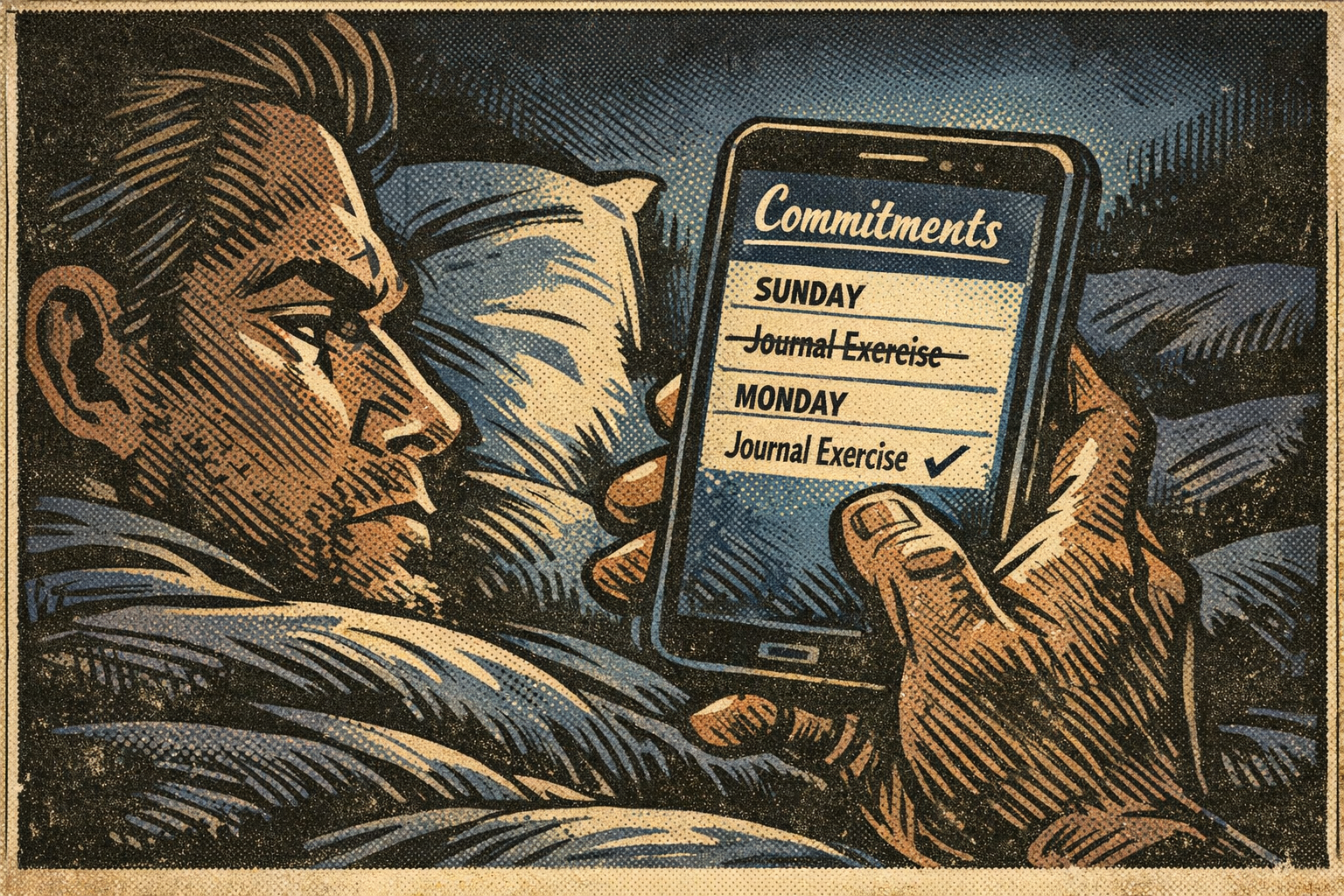
Behavioral science offers a useful lens here. Human beings are wired to conserve energy. When friction appears—fatigue, inconvenience, competing demands—we instinctively seek relief. Renegotiating a deadline provides that relief without the discomfort of open failure.
The mind reframes it as practicality.
But direction matters.
When a Sunday commitment becomes Monday afternoon, the change feels small but the lesson you leave with is that resistance should result in delay rather than adaptation.
There is another option, though less comfortable. If Sunday is constrained, move the ritual to Saturday. Or Friday. Advance it rather than postpone it. Preserve the standard even if the container shifts.
That directional choice is identity-forming.
In my own life, I learned that the ritual must be immovable, even if the hour is not. The week must be calibrated before it begins. That line does not slide backward.
And when clients begin to slide it—Sunday night becomes Monday afternoon, week after week—I know the issue is not scheduling. It is sovereignty.
The Illusion of Flexibility

There is, of course, a counterargument. Life is complex. Work expands. Family demands surge. Flexibility is necessary. Rigidity can become brittle.
This is true.
But flexibility that consistently points toward delay is not flexibility; it is erosion.
The distinction lies in whether the adjustment protects the principle or dilutes it. If the ritual must happen before the week begins, then moving it earlier preserves its purpose. Moving it later compromises it.
Compassion is essential. But compassion that lowers the bar rather than strengthens resolve breeds mediocrity disguised as kindness.
The Sunday ritual is not sacred because of superstition. It is sacred because it anchors direction before reaction. When that anchor drifts, so does the man.
The Structure Beneath the Practice
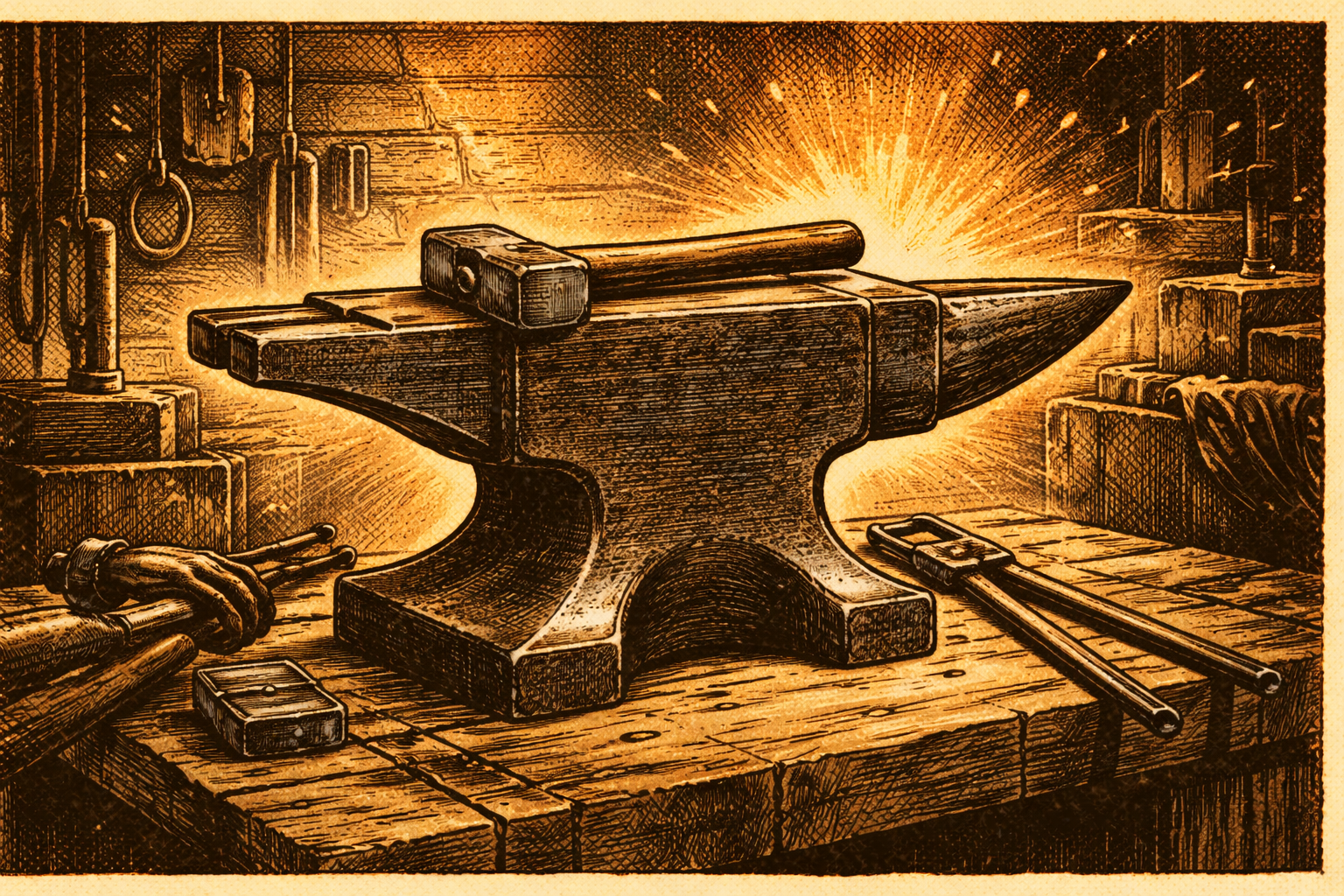
In my coaching framework, I think of weekly commitments as part of the internal structure that allows growth to occur. Every craftsman needs a stable surface on which to work. Without it, effort scatters.
A weekly calibration is that surface.
When it holds, pressure produces shape. When it shifts, effort disperses.
Consistency is not about intensity. It is about reliability. It is about showing up at the same place in time and declaring, again and again, who you intend to be.
That repetition builds confidence. Not the loud kind, but the quiet assurance that comes from knowing you keep your word to yourself.
When I restored the ritual—added ceremony, treated it as non-negotiable—that confidence returned. My weeks felt authored. My coaching felt grounded. I was not chasing tasks; I was executing intention.
Returning to the Line

If you have slipped in your consistency, you likely did not do so in defiance. You did so gradually. A reasonable adjustment here. A minor delay there. The drift felt harmless until direction blurred.
The solution is not shame. It is restoration.
Return to the line. Reinstate the ritual. If Sunday is tight, move it earlier. Protect the principle. Add ceremony if you must. Remove friction. Make the practice visible and deliberate.
The value of a weekly calibration is not in the pages you fill. It is in the identity you reinforce, anchored as a man who sets direction before the world sets it for him.
I have lived both versions—the reactive week and the directed one. The difference is not talent or intelligence or even workload. It is a single hour held with integrity.
Discipline rarely disappears in flames. It fades in inches.
And it returns the same way—one restored line at a time.