You are reading the last Principle in this Marriage Series. Each builds on the one before it. These are structural commitments that form the framework of a marriage that does not drift when emotion shifts.
Start here: A Letter to the Man Who Knows Something Is Off.
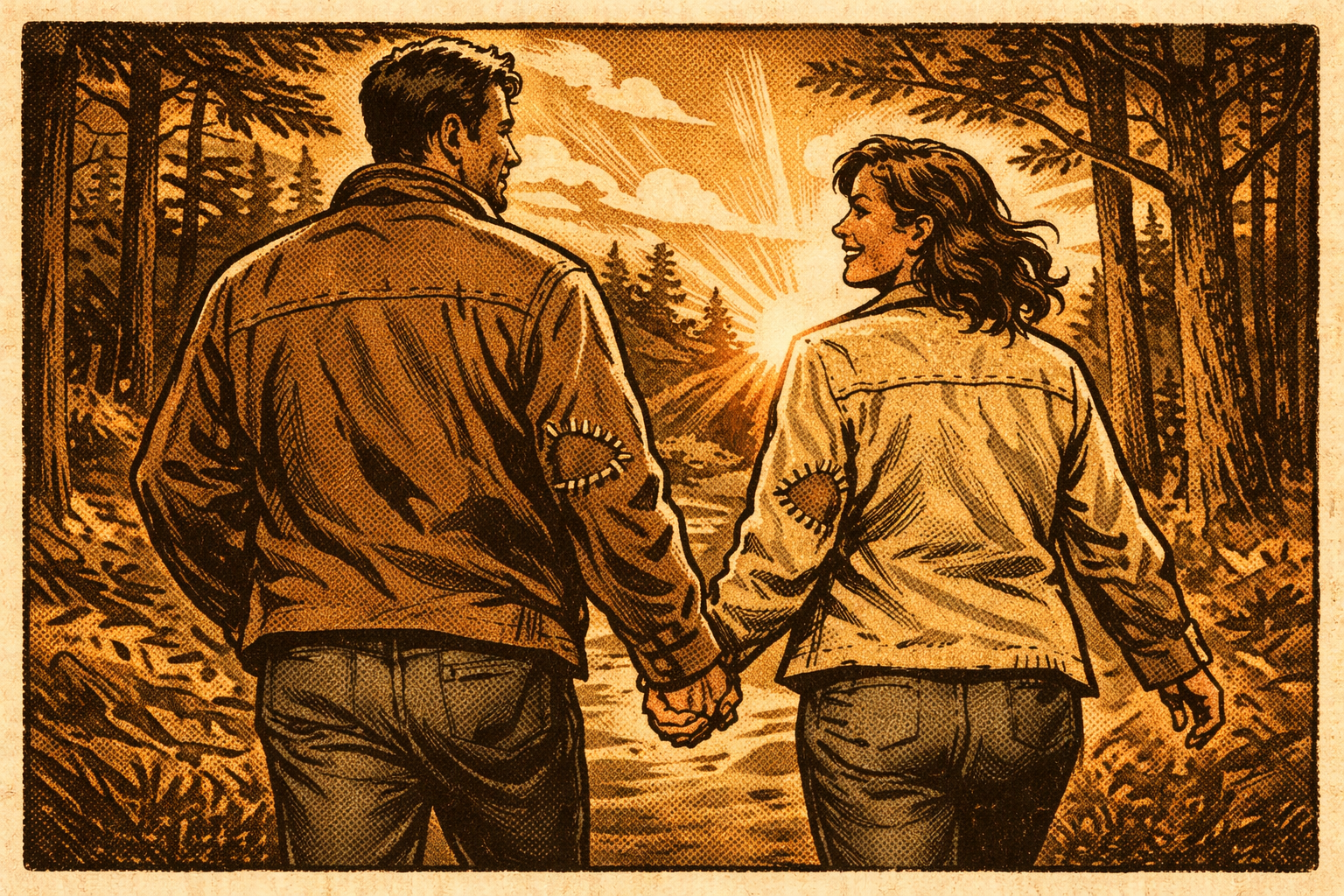
A man who throws away a jacket because it has torn at the elbow has misunderstood what made it valuable in the first place. The rip is not proof of worthlessness. It is evidence of wear, of movement, of real use. What matters is not the tear itself, but what he does next.
Marriage resembles that jacket more than most men want to admit. It carries the weight of seasons. It absorbs strain. It stretches at the seams when life pulls hard. And when something splits, when a sharp word lands or silence lingers too long, the instinct can be to treat the damage as verdict. Something is wrong with her. Something is wrong with us. Something is irreparable.
That instinct is false. The presence of a tear does not determine the future of the garment. The willingness to stitch does.
Repair is not sentimental reconciliation. It is deliberate craftsmanship applied to damage. It requires a man to examine the seam without flinching, to hold the fabric steady, and to pass the needle through both sides of the split until what was separated is joined again.
The strength of a marriage is not measured by how rarely it tears, but by how reliably it is repaired.
Tears Are Inevitable in Anything Worn Closely
A jacket that is never stressed never tears. It also never protects anyone from the cold. Intimacy exposes fault lines because it invites proximity. Two lives woven tightly together will experience friction. Pressure from work, children, fatigue, disappointment, and old wounds does not politely bypass the relationship. It presses directly against it.
Conflict, then, is not an anomaly. It is a byproduct of closeness. The question is not whether strain will occur, but whether the man inside the marriage understands his role when it does.
Many men respond to relational damage the way an impatient owner might respond to a rip. They toss the jacket aside in frustration. They let it sit in the closet, telling themselves they will deal with it later. Or worse, they keep wearing it without addressing the tear, allowing it to widen with each movement.
In marriage, this looks like withdrawal. It looks like cold civility. It looks like sleeping beside each other while the seam continues to split in silence. Distance becomes a substitute for repair. Pride becomes a substitute for skill.
Yet a rip left unattended grows. The fibers separate further. What was once a minor split becomes structural weakness. The fabric does not fail all at once. It erodes.
Repair Demands Ownership of the Seam
To stitch a jacket, a man must first acknowledge where the tear is and how it formed. Perhaps the fabric caught on a nail. Perhaps it thinned from repeated strain. Whatever the cause, the one holding the needle does not begin by blaming the cloth. He begins by taking responsibility for mending it.
In marriage, repair begins with the same posture. After conflict, the crucial question is not who won the argument. It is where I contributed to the rupture. Did my tone sharpen the moment. Did my silence widen it. Did my pride prevent softness when softness was needed.
Ownership is not self-erasure. It is clarity. It is the refusal to hide behind technical correctness when the relational seam has still split. A man who leads through repair does not wait for his wife to make the first move toward reconnection. He does not require her apology as precondition for his humility. He recognizes that the health of the garment depends on his willingness to handle the needle.
The act itself is rarely dramatic. It may be a clean apology without qualifiers. It may be revisiting a conversation with calmer words. It may be naming how his reaction caused harm and committing to change it. The stitch is small, but its effect is structural.
Precision Strengthens What Was Once Weak
A properly repaired seam is often stronger than the surrounding fabric. Reinforcement occurs where the tear once threatened collapse. The area of prior weakness becomes a point of resilience.
This is the overlooked power of repair in marriage. Conflict addressed with responsibility does not merely return the relationship to neutral. It increases its capacity. When a man steps toward reconnection after damage, he communicates something essential. Disagreement will not end us. Tension will not exile you. I am not retreating.
Psychologically, this consistency creates safety. Emotional security does not arise from perfection. It arises from predictable restoration. When a wife learns that rupture will be followed by sincere repair rather than distance or punishment, her nervous system settles. The home becomes stable not because storms never pass through, but because they are handled.
Repair also disciplines the man himself. It forces regulation. He cannot stitch effectively with shaking hands. He must slow down, steady himself, and focus on alignment. In doing so, he strengthens not only the seam but his own character.
The Temptation to Discard
There is a persuasive alternative narrative that treats tears as evidence of incompatibility. If it ripped, perhaps it was never well made. If we fight, perhaps we are wrong for each other. If I feel frustrated, perhaps I deserve something smoother.
This logic has cultural reinforcement. Convenience is celebrated. Replacement is easier than repair. Entire industries are built on the promise of upgrade over maintenance.
Applied to marriage, this mindset misinterprets strain as failure rather than normal wear. It assumes that a healthy relationship should remain effortless. When difficulty arises, the conclusion is that something fundamental is flawed.
But this reasoning confuses discomfort with dysfunction. All long used garments show signs of stress. The presence of tension says little about quality. The absence of repair says much more.
Discarding a jacket avoids the labor of stitching. Avoiding repair in marriage protects ego in the short term. One does not have to admit fault, soften posture, or revisit uncomfortable moments. Distance feels cleaner than humility.
Yet what appears easier often proves more costly. A closet full of abandoned jackets does not make a man warmer. A history of unresolved ruptures does not make a man fulfilled. It leaves him practiced in exit rather than endurance.
The Craft of Returning
Repair is an active return. It is the movement back toward closeness after separation. It is the decision to bridge rather than widen the gap. This movement must be initiated by someone. In a strong marriage, the husband chooses to be that someone.
He does not minimize his wife’s hurt. He does not rationalize his harshness as justified. He studies the tear. He names it plainly. He threads the needle with sincerity and patience.
He also understands that stitching once is not enough if behavior remains unchanged. A seam pulled apart repeatedly in the same place signals deeper neglect. Real repair includes adjustment. He handles the garment differently. He pays attention to strain points. He strengthens the area with care.
Over time, these acts accumulate. The marriage develops reinforced seams where conflict once lived. The couple trusts not in the absence of disagreement, but in the reliability of restoration.
A man who practices repair becomes steady under pressure. He stops viewing conflict as personal defeat. He sees it as maintenance. Something has frayed. It needs attention. He provides it.
The Value of What Is Worn
A favorite jacket carries memory. It fits in ways new garments cannot. It has adapted to the shape of the wearer. Its worth increases with time because it has been present through seasons.
Marriage holds similar value. It is not interchangeable. It is shaped by shared history, by inside jokes, by difficult nights survived together. When torn, it deserves attention rather than dismissal.
Repair honors that history. It treats the relationship as worthy of care. It assumes that damage is not disqualifying. It affirms that what has been worn closely is worth preserving.
A man who understands this does not panic at the sight of a split seam. He does not dramatize ordinary strain. He reaches for needle and thread. He sits down. He does the work.
The tear does not define the jacket. The repair defines the owner.
In marriage, rupture will come. What determines the strength of the bond is whether the man responds with distance or with stitching. When he chooses to mend rather than abandon, he transforms weakness into reinforcement. The seam, once fragile, becomes the strongest line in the fabric.
And the garment, worn again with care, holds.
Step Into IGNITION
Every relationship will fracture.
The question is not if.
It is who moves first.
- Continuity.
- Protection.
- Kindness.
- Honesty.
- Understanding.
- Acceptance.
- Repair.
These are not romantic ideals.
They are disciplines.
Most men agree with them.
Few embody them.
Because embodiment requires structure.
- Repetition.
- Brotherhood.
- Accountability.
It requires fire.
If you’re done being a man who knows what he should do and ready to become a man who actually does it… You don’t need more content.
You need structure.
You need challenge.
You need men holding the line with you.
Step into the fire.
Build the man she can trust.
Build the man you respect.
Learn more about IGNITION — our brotherhood for men ready to forge themselves.